
Introduction
Picture the scene everyone pictures. A circle of teenagers, someone holding something out, someone else saying go on, don't be boring. That image is what the phrase peer pressure was built to describe, and it is what almost every article on the subject is still describing.
Now look at how the research was actually done.
In the study that turned this into a neuroscience question, the friends were not in the room. They sat in the scanner control room next door, watching a monitor. They were allowed to speak to the participant during the breaks and not during a single decision. The 14 adolescents in that scanner took more risks anyway, and the extra risk showed up as activity in the brain's reward system rather than anywhere that looks like giving in [1].
Then a follow-up removed the friendship. The observer was a stranger. Same age, same gender, a voice on a two-way radio from another room, introduced for a moment and then silent. Across 64 late adolescents the effect held [2].
Hold that one in your head for a second. No friendship was at stake and no reputation with anyone the teenager would ever meet again, and the behaviour changed anyway.
Then a lab ran the whole thing on mice. In a 2013 study adolescent mice drank more alcohol with company than alone, and adult mice drank the same either way [3]. Mice do not talk anyone into anything.
So the honest version of the sentence is not that friends pressure teenagers into things. It is stranger and more interesting than that. Being watched by someone your own age changes how good a risk feels, and in adolescence that change is large enough to measure in a scanner. Nobody has to say a word.
This article follows that finding from the experiment that started it, through the argument the field is still having about what it means, to the part almost nobody mentions. The same wiring makes teenagers more generous, and one school programme built on it was tested on more than ten thousand students in a randomised trial in The Lancet.
The Experiment Everyone Half Remembers
The founding study is from 2005 and it is remarkable how rarely it gets named.
Margo Gardner and Laurence Steinberg recruited 306 people in 2005 and split them into three age bands: adolescents aged 13 to 16, youths aged 18 to 22, and adults aged 24 and over [4]. Everyone filled in two questionnaires about risk and then played a computerised driving game where you can run an amber light to save time and lose everything if you misjudge it.
Here is the part that made it an experiment rather than a survey. Each person was randomly assigned to do all of it alone, or to do all of it with two same-aged peers in the room.
The results split cleanly by age. Risk taking fell as people got older, which surprises nobody. Everyone was riskier in company than alone, which surprises nobody either. The interesting number is how much riskier, and for whom.
Summarising that task in 2013, the field's own review puts it this way. Early adolescents scored twice as high on an index of risky driving when tested with peers present than when tested alone, late adolescents were approximately 50 percent riskier in groups, and adults showed no difference at all related to social context [5].
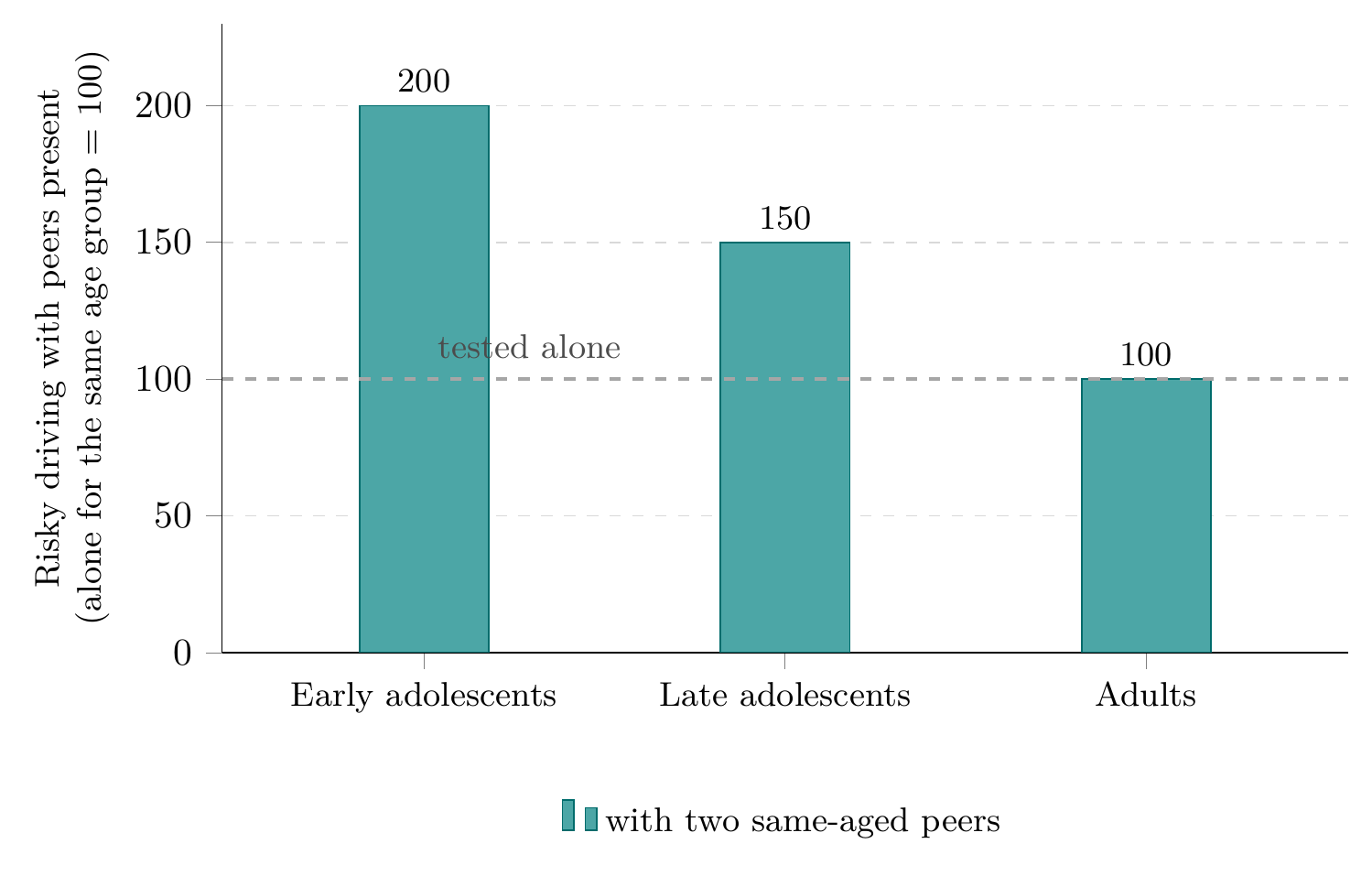
Data from Gardner and Steinberg 2005 as reported in Albert Chein and Steinberg 2013. Chart by Mindomax.
Read the right-hand bar first, because it is the one you are least likely to expect. The adults did not move. Put two people their own age in the room with a 37 year old and their driving does not change in any measurable way. That flat bar is what makes the other two mean something, because without it you would just be looking at teenagers being teenagers.
The Number That Grew On Its Way To You
Before going further, one piece of housekeeping, because you have probably met a different version of that figure.
The claim that circulates online is that teenagers take three times as many risks when friends are watching. The primary literature does not report it. The figures are two times for the youngest group and about 50 percent for the older adolescents, with adults unchanged.
Twice is a striking result. It did not need your help or anyone else's.
This matters beyond pedantry. An inflated number is the thing a sceptical reader checks first, and when it does not hold up they stop believing the rest of the paragraph, including the parts that are solid. So the rule for the rest of this article is that every figure arrives with the study that produced it and the number of people it was measured on.
Then They Moved The Friends Out Of The Room
Six years after the driving game, Jason Chein and colleagues put the question in a scanner.
The design was small, and it is worth saying so plainly. Forty people in total: 14 adolescents aged 14 to 18, 14 young adults aged 19 to 22, and 12 adults aged 24 to 29 [1]. Forty is not a large sample. It is a normal one for imaging work of that era, and the behavioural result underneath it had already been established on 306 people.
Participants played the Stoplight task, a simple driving game seen from the driver's seat, twice. Once alone. Once while two friends they had brought with them watched from the neighbouring scanner control room.
That is the detail worth sitting with. The friends were behind glass, looking at a monitor. They spoke to the participant during the breaks over the scanner intercom, and not while any decision was being made. There was nothing to give in to.
The 14 adolescents took more risks under observation and the 12 adults did not. Being watched raised the adolescents' risky decisions at t(13) = 2.16 with p = .025 and their crashes at t(13) = 4.06 with p < .001, and in the adolescent brains it produced greater activation in reward-related regions including the ventral striatum and the orbitofrontal cortex, with the size of that activation predicting how much risk the person went on to take [1].
There is one more result in that paper, and it is the one that reframes everything.
The Brake That Never Moved
The story you have heard about the teenage brain runs like this. There is an accelerator, which matures early, and a brake, which does not finish until the mid twenties. Friends push the accelerator. The unfinished brake fails to stop the car.
It is a good story. The imaging data does not support the second half of it.
Regions associated with cognitive control were indeed less strongly recruited by the 14 adolescents than by the 12 adults. But activity in that control system did not vary with social context at all [1]. It was the same whether the friends were watching or not. The thing that moved when the friends appeared was the reward side, and only the reward side.
That is a different claim. Nobody's self-control failed. What changed was the value of the thing self-control would have had to argue against.
There is a nice supporting detail in the same 2010 paper. Across all three age groups, the more a person's ventral striatum lit up under observation compared with being alone, the lower they scored on a questionnaire measure of resistance to peer influence, at r = -.54 with p < .01 [1]. The brain measure and the self-report measure agreed.
The dotted line is the finding. The control system is in the picture, it is doing its job, and the arrival of an audience does not touch it. Everything that happens, happens on the left.
That result has since been repeated with the audience made deliberately anonymous. In a 2018 imaging study adolescents took more risks and showed heightened striatal activation when they believed an anonymous peer was watching, while response inhibition was unaffected and cognitive control regions barely moved [6]. Two independent designs, same split, same half of the brain doing the work.
If you want the structural companion to this, the same brain is busy remodelling itself during exactly these years, and we have written about what synaptic pruning does to the adolescent cortex separately.
A Stranger Will Do
If the mechanism were social pressure, a friend should matter and a stranger should not. So someone tested that.
Alexander Weigard and colleagues recruited 64 late adolescents aged 18 to 22 in 2013 and gave them a delay discounting task, which is a way of measuring impatience with money. Would you rather have 500 dollars now or 1,000 dollars in six months? The point at which you stop preferring the immediate option is your indifference point, and it is a fairly stable trait.
Half of them did it alone. The other half did it believing they were being observed by an anonymous peer of the same gender and roughly the same age, over a two-way radio from a neighbouring room, after a brief introductory exchange and with no chance to talk during the task itself [2]. The observer was a voice. Not a friend, not a face, not a name.
The watched group became measurably more impatient. Their indifference points averaged 656.68 dollars against 768.16 dollars for those working alone, a difference reported at F(1,62) = 8.58, p < .01 [2].
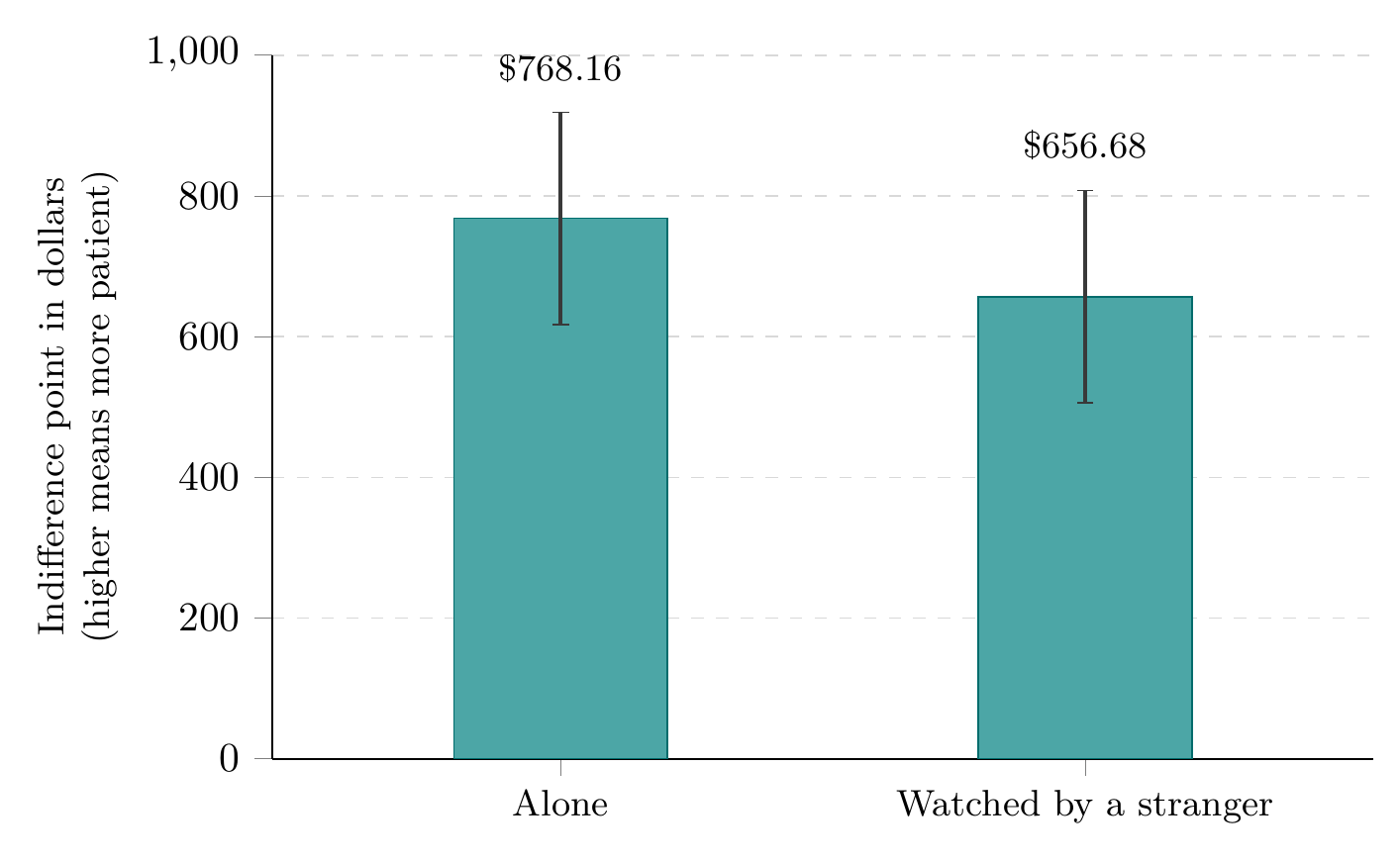
Data from Weigard Chein Albert Smith and Steinberg 2013. Chart by Mindomax.
Two participants were dropped from the analysis for not believing the manipulation, which is worth mentioning because it tells you what the manipulation was. There was no real audience. There was the belief that someone their own age might be listening, and that belief moved a stable economic preference by about 111 dollars.
Being watched by a stranger who cannot speak to you is not peer pressure by any definition of the phrase.
They Could See The Odds
The next objection writes itself. Maybe teenagers just do not understand risk, and company distracts them from thinking it through.
Ashley Smith, Jason Chein and Laurence Steinberg tested that directly in 2014 with 52 adolescents aged 15 to 17, of whom 46 were included in the analysis [7]. They used a gambling task built around a spinning wheel divided into coloured segments. You could win 10 tokens, lose 10 tokens, or get nothing, and the size of each segment showed exactly how likely each outcome was. The odds were not hidden or implied. They were drawn on the screen at the size of the thing they represented.
Peer observation made no difference when the odds were good. At ratios of 1.5 to 1, 1 to 1, and 0.81 to 1, watched adolescents gambled about as much as unwatched ones.
The effect appeared only as the odds got worse. At 0.67 to 1, t(44) = 3.57, p = .001. At 0.50 to 1, t(44) = 2.88, p = .006. At 0.33 to 1, t(44) = 2.34, p = .02 [7].
Read that pattern carefully, because it is the opposite of what you would expect from confusion. A confused participant would gamble more or less across the board. These adolescents tracked the odds perfectly well when the bet was sensible, and departed from them precisely where departing costs something. They knew. Being watched changed what the knowing was worth.
Four designs, four different ways of removing the persuasion, and the effect keeps surviving.
And Then There Were The Mice
The cleanest argument against the persuasion story does not involve people.
Sheree Logue and colleagues gave adolescent and adult mice access to alcohol in 2013, either alone or in the presence of other mice, and only the adolescent animals drank more with company [3]. The adults drank the same either way.
You cannot dare a mouse, and you cannot shame one either. There is no social status at stake, no worry about looking boring, no group identity to perform. What there is, in a mouse and in a fifteen year old, is a reward system that responds differently to the same substance depending on who else is in the enclosure.
Animal work has to be labelled as animal work, and this is a mouse study, not evidence about human teenagers. What it does is narrow the range of explanations. Any account of the peer effect that requires language, reputation or persuasion now has to explain why it also happens in a species that has none of those things.
Two Clocks, Not One Broken Part
So what is the developmental story, if it is not a missing brake?
The standard answer is the dual systems model, and it starts with a large descriptive study. In 2008 Laurence Steinberg and colleagues measured sensation seeking and impulse control in 935 people aged 10 to 30, using both self-report and behavioural tasks [8]. The two did not move together. Sensation seeking climbed through early adolescence and then fell away. Impulse control rose slowly and steadily and kept rising into the twenties.
Two curves. Different shapes, different timing, and if you have only ever met the one-curve version you have been told half of it. For a few years in the middle they are far apart, and the 2010 statement of the model claims that this gap is what adolescence is, at least from a risk-taking point of view [9].
Notice how different that is from the broken-brake story. Nothing is missing. Nothing is failing. Two normal developmental processes are running on separate schedules, which is a description rather than a diagnosis. There is no defect in the picture and no point at which the brain becomes finished.
The two systems really do behave like separable things rather than two readings of one trait. Working with 7,640 youth in 2011, Paige Harden and Elliot Tucker-Drob found that sensation seeking rose to a peak around age 16 and then declined while impulsivity fell steadily from age 10 onward, which is two different shapes rather than one curve seen twice [10].
The model was restated and defended by its authors in a 2016 review titled review, reappraisal and reaffirmation, which is not the title of a paper written by people who feel unchallenged [11].
They were not.
The Argument The Field Is Actually Having
Here is where most articles about the teenage brain stop, and it is where this one gets interesting. The explanation above is contested, in detail, by serious people, and has been since 2012.
Jennifer Pfeifer and Nicholas Allen opened the case in 2012 in Trends in Cognitive Sciences under the title "Arrested development? Reconsidering dual-systems models of brain function in adolescence and disorders" [12]. Their objection is that a two-box model of a brain with dozens of interacting systems buys its clarity by throwing away most of the biology, and then gets applied to clinical questions it was never tested on.
Teena Willoughby and colleagues went at the empirical link in 2013, arguing in Brain and Cognition that the connection drawn between adolescent brain development and real-world risk taking is considerably weaker than the popular account implies, and that a social-developmental reading explains the same behaviour without the neural machinery [13].
Daniel Romer, Valerie Reyna and Theodore Satterthwaite made the broadest version of the case in 2017, under a title that says it outright: beyond stereotypes of adolescent risk taking [14]. Their argument is that most adolescents are not reckless, that the ones who are tend to stay that way into adulthood, and that treating a whole developmental stage as a risk factor gets both the science and the policy wrong. Romer had already sketched an alternative in 2010 in which exploration and experience-seeking, rather than deficient control, do most of the explanatory work [15].
You can read that as academic point-scoring if you like. It is not. The policy consequences are direct, because a court, a school board or a parent who believes adolescence is a period of diminished capacity treats a teenager differently from one who believes it is a period of heightened social learning.
Then there is the methodological complaint, which is the least glamorous and possibly the most damaging. In 2019 Samuel Meisel and colleagues reviewed how the model gets tested statistically and found the tests frequently do not do what their authors think they do, particularly when researchers claim an imbalance between two systems without ever modelling the imbalance as such [16]. Their paper is called "Mind the gap". Checked against two normative longitudinal cohorts of 1,522 and 784 young people rather than samples selected for risk, support for the standard dual systems predictions came out patchy [17].
The most honest entry in this argument comes from inside the research programme. Lauren Sherman, Laurence Steinberg and Jason Chein published a paper in 2018 on the strengths and limitations of connecting brain responsivity to real-world risk taking, which sets out plainly what a scanner result can and cannot tell you about what a teenager does on a Friday night [18].
Notice who is saying this. Some of these names are the same people who built the model in the first place, publishing the limits of their own framework in the same journals. That is what a healthy argument looks like from the outside, and it is worth knowing about before you read the next confident summary of what the teenage brain is doing.
More recently the framing itself has come under attack. Joseph Allen argued in 2024 for a strengths-based reading of adolescent peer influence and risk taking [19], and in 2025 B. J. Casey and colleagues published a paper called "The beautiful adolescent brain", whose argument is that the deficit language was never a neutral description of the data [20]. There is even evidence about what the labelling does, since a 2022 paper asked adolescents themselves what they make of being described as risk-takers and the answers were not enthusiastic [21].
So where does that leave the reader?
The behavioural finding is not in dispute. Peers present, more risk, in adolescents and not adults, across tasks and countries and one rodent species. What is in dispute is the explanation, and specifically whether a two-system developmental account is the right shape of explanation or a tidy diagram that outran its evidence. Anyone who tells you that part is settled is selling you something.
Eleven Countries
One reasonable worry about all of this is that it is a finding about American undergraduates, which a great deal of psychology turns out to be.
Natasha Duell, Laurence Steinberg and a group of 19 authors tested the dual systems account in 2016 on more than 5,200 people aged 10 to 30 drawn from 11 countries [22]. The companion paper, published in 2017 with more than 5,000 participants from 11 countries across Africa, Asia, Europe and the Americas, found sensation seeking peaking at age 19 and self-regulation rising steadily into the twenties almost everywhere they looked [23].
That is about as good a generality check as developmental psychology manages.
It is not the same as saying culture does not matter. A 2017 meta-analysis of 75 longitudinal studies across 16 countries found that having peers who smoke was associated with roughly twice the odds of an adolescent starting to smoke, at an odds ratio of 1.96 with a confidence interval of 1.76 to 2.19. For continuing to smoke rather than starting the figure was an odds ratio of 1.78 running from 1.55 to 2.05, and both associations were stronger when the adolescent felt close to those peers and stronger again in collectivistic cultures [24]. The machinery appears to be common. How hard it pulls is local.
Whose Opinion Counts, And For How Long
Not every peer is equal, and the difference is measurable.
Lisa Knoll and colleagues asked 563 people in 2015 to rate everyday situations for how risky they were, then showed them ratings supposedly given by other people, then asked them to rate everything again. Some participants were told the other ratings came from teenagers. Others were told they came from adults [25].
Everyone shifted toward whatever they had been shown. Only the youngest adolescents shifted more toward the teenage ratings than the adult ones. To a twelve or thirteen year old, what other teenagers think about risk carries weight that adult opinion does not. That preference fades with age.
Susceptibility fades too, but later than parents would like. Pooling four samples totalling more than 3,600 people aged 10 to 30, Laurence Steinberg and Kathryn Monahan reported in 2007 that resistance to peer influence rises linearly between ages 14 and 18 and shows little growth at all between 10 and 14 [26]. The years when peer influence is strongest are precisely the years when the ability to resist it has not started developing yet. That is not a coincidence, it is one schedule seen from two sides.
There is also a condition under which peers matter most, and it is a useful one. Anaïs Osmont and colleagues gave adolescents a balloon-pumping risk task in 2021 in two versions, one where the risk was stated and one where it was not, and peers' previous choices swayed behaviour on the uninformed version and not on the informed one [27]. Uncertainty is what social information fills.
Which is worth remembering. If you want a teenager to be less swayed by what everyone else is doing, giving them the actual numbers does more than telling them not to be swayed. The related question of how self-control develops on its own timetable is covered in our piece on what the delayed gratification research really found.
Peer Pressure Was Never One Thing
The phrase has been doing shaky work for a long time, and somebody said so in 1985.
Donna Rae Clasen and B. Bradford Brown surveyed 689 adolescents in 1985 and found that peer pressure was not a single force at all [28]. Their respondents reported pressure running in several distinct directions at once, and some of the strongest ran toward school involvement and family conformity rather than away from them. The pressure to misbehave was one strand among several, and not the largest.
Forty years of work since has gone on complicating it further. Whitney Brechwald and Mitchell Prinstein's 2011 review sets out how much of what looks like influence is actually selection, because adolescents choose friends who already resemble them, and how much of the rest runs through reputation and status rather than instruction [29].
Selection is the part most people miss, and it changes what you can conclude from any of this. If a teenager who already likes risk goes looking for friends who like risk, then some of what looks like influence in a survey is just two similar people finding each other.
The most direct modern test of the status reading is recent. Working with 250 adolescents in 2024, Nathan Field and colleagues found that conformity was directed specifically at high-status peers and was bound up with identity alignment, with who the adolescent was trying to be [30]. This is not somebody caving. It is somebody choosing a group and then behaving like a member of it. A 2021 experiment on how norms form found the same logic at group level, with the norm of the majority shifting adolescents' own judgements more than the norm of a single popular peer did [31].
Which fits the identity work. The teenage years are when the question of who you are gets asked seriously for the first time, and as a 2021 decade-in-review of identity development put it, a peer group is one of the few available answers [32].
If you want the adult baseline for comparison, Solomon Asch demonstrated in the 1950s that grown adults will deny the evidence of their own eyes to agree with a group, and we have written about what the Asch conformity experiments actually showed. Adults are not immune to any of this. They are just less moved by an audience of their peers than a fifteen year old is.
The Same Wiring, Pointed Somewhere Else
Everything so far has been about risk, because that is what got funded and that is what makes headlines. It is half the picture, and the missing half changes the meaning of the first.
A 2022 study found that adolescents allocating money privately between themselves and a peer behaved selfishly, and that the same adolescents became more altruistic when a peer was present, with decision-process modelling showing the shift came from faster evaluation of the other person's outcome [33]. The same audience effect. A different direction entirely.
It shows up in the brain too. Scanning 61 adolescents during a public goods game in 2016, Jorien van Hoorn and colleagues found that prosocial peer feedback recruited its own neural signature rather than a weakened version of the risky kind [34]. Testing 755 participants in 2018, Lucy Foulkes, Sarah-Jayne Blakemore and colleagues found the prosocial influence effect present in every age group but strongest in the youngest [35].
That is the finding to sit with if you only take one away from this section. The audience effect has no direction of its own. Point it at a group that finds generosity impressive and you get generosity, at the same speed and through the same machinery.
Eva Telzer made the general argument in 2016. Heightened dopaminergic reward sensitivity in adolescence is not intrinsically a hazard, and depending on what the reward is attached to it can promote health rather than damage it [36]. A 2023 review argues that peers help with emotion regulation, a job usually assigned to parents [37].
Read together with a 2025 review arguing that adolescent plasticity is a learning asset rather than a vulnerability [38], the picture is of a system built for social learning that happens to get measured most often when it produces something regrettable. The reward machinery underneath all of it is the same machinery we describe in our article on how dopamine teaches the brain, and it has no opinion about whether what it is learning is good for you.
It Is Already Being Used As Medicine
If peer influence is a channel rather than a hazard, you should be able to send something useful down it. Somebody did, and they tested it properly.
The ASSIST trial randomised 59 schools and 10,730 students, and instead of lecturing anyone it identified influential students and trained them to have ordinary conversations with their friends about not smoking. Published in The Lancet in 2008, it pooled all three follow-ups into a single model and put the odds of being a smoker in an intervention school at 0.78 relative to a control school, with a confidence interval running from 0.64 to 0.96 [39].
A 2016 systematic review of peer-led interventions against tobacco, alcohol and drug use in 11 to 21 year olds reached the same figure independently, pooling the trials to an odds ratio of 0.78 for smoking with a confidence interval of 0.62 to 0.99 and p = 0.040 [40].
That is what a mechanism-based reading buys you. If the story were pressure, the intervention would be teaching refusal skills, which is what most school programmes still do. If the story is that peers change how rewarding something feels, then the intervention is changing what the peers make rewarding.
What It Looks Like At Sixteen With A Driving Licence
The laboratory results have an obvious real-world counterpart, and it is the one every insurer already knows about. It is also messier than the laboratory.
Marie Claude Ouimet and colleagues put 36 male drivers aged 16 to 17 in a simulator in 2013 with either a risk-accepting or a risk-averse passenger, and got a result that ran against their own hypothesis: the drivers carrying the risk-accepting passenger kept significantly longer headway and glanced at hazards more often [41]. Raymond Bingham, Bruce Simons-Morton and colleagues ran 53 male 16 and 17 year olds through a similar design in 2016 with the passenger's norms and explicit encouragement manipulated together, and found the risky passenger produced twice the rate of failing to stop at yellow lights and roughly ten times the probability of overtaking, with the confidence interval on that first ratio running from 1.06 to 4.43 [42].
Those two results point in different directions and both are real. So ask the drivers.
Catherine McDonald and Marilyn Sommers ran seven focus groups with 30 drivers aged 16 to 18 in 2016 and asked them how peer passengers affect their driving [43]. The paper is titled with one of their answers. "There can be good passengers and not good passengers," said a 17 year old girl, and the whole study is an argument for taking that distinction seriously.
Several of them insisted friends made them safer. "I feel like when my friends are in the car, I am more attentive and stuff," said another 17 year old. A boy of 18 explained why: "And I think it is probably because you have a friend in the car. And it is like that is somebody else's life that is in your hands." One 17 year old boy pointed at something the simulator studies cannot capture at all: "You feel less alone. And you do not have the urge to text or call anyone."
Take that seriously rather than dismissing it as teenagers being unreliable narrators. A passenger who reads the map, watches for hazards and answers your phone is a genuine safety asset, and the same passenger daring you to overtake is a genuine hazard. That is not two opinions about one effect. It is two effects, and the word peer pressure hides the difference between them.
Why Being Left Out Hurts More At Fifteen
None of this explains why an adolescent should care so much about an audience in the first place. That part has its own literature.
Scanning 23 adolescents while they were excluded from a simple online ball game in 2009, Carrie Masten, Naomi Eisenberger and colleagues found that the distress of peer rejection has a neural signature overlapping regions implicated in physical discomfort [44]. Kipling Williams' 2007 review of ostracism describes how fast and how reliably exclusion registers, even when the excluding group is meaningless to the person being excluded [45].
Sarah-Jayne Blakemore's group has spent two decades documenting what they call the social brain in adolescence. Their 2016 integrated review describes an extended reorganisation across the teenage years of the regions involved in thinking about other minds [46].
You already know how this feels, because you were fifteen once and the memory of being left out of something has probably outlived the thing itself.
Leah Somerville's 2013 review makes the sharper point that adolescence brings a specific sensitivity to being evaluated, not just to being included [47]. When the pandemic shut schools in 2020, the same field argued that adolescents were the age group for whom social deprivation would be most costly, precisely because of that developmental window [48], and that peer influence should be treated as a public health variable rather than a nuisance [49].
Put it together. Belonging is not a preference at fifteen, it is closer to a requirement, and the drive toward it is one reason a teenager will accept a cost an adult would not. The broader account of why relatedness sits alongside competence and autonomy as a basic psychological need is in our article on self-determination theory.
There is a nice control condition on all of this, and it involves parents. Scanning 23 adolescents in 2016, João Guassi Moreira and Eva Telzer found that maternal presence modulated reward sensitivity during risk taking in its own distinctive way rather than acting as a weaker version of peer presence [50]. With 56 adolescents in 2018, van Hoorn and colleagues found the same thing at the neural level, where parent presence and peer presence produced different effects on risk-taking circuitry rather than different amounts of one effect [51]. Being watched is not one thing either. It depends entirely on who is doing the watching.
The Version With A Screen In It
The obvious modern question is whether any of this transfers online, where the audience is permanent and enormous.
The honest answer is that the evidence is thinner than the discourse. Scanning 61 adolescents and young adults in 2018, Lauren Sherman and colleagues showed them Instagram-style photographs carrying high or low like counts and found that peer endorsement changed both what they liked and how their reward circuitry responded [52]. That is the peer effect operating through a metric on a screen, which is exactly what you would predict from the laboratory work.
What that does not license is the broader claim about screens and a generation, and the broader claim is where most writing on this subject lives.
What Any Of This Is Actually Good For
A mechanism is more useful than advice, so here is what changes if you take the mechanism seriously.
The standard intervention is aimed at the wrong target. Teaching a teenager to say no addresses persuasion, and persuasion is not what the experiments found. If the effect runs through how rewarding something feels while being watched, then refusal scripts are answering a question nobody asked, which is one reason the ASSIST approach of changing what the peer group makes rewarding outperformed the lecture.
That points at the composition of the group rather than the strength of the individual. Peer influence has no preferred direction, so who a teenager spends time with is a stronger lever than how much willpower they have, and it is also the lever adults have more access to.
Underneath both sits the Osmont result, which is the most immediately usable thing here. Social information fills a vacuum, and the pull of what everyone else is doing shrinks when the actual risk is spelled out. Specific numbers beat general warnings, and that is a small finding with unusually practical consequences.
All of that has a window attached to it. Peer influence peaks in early adolescence while resistance to it does not begin rising until around 14, and the gap between those two schedules is where most of the trouble sits. Knowing where the gap is beats being surprised by it.
And there is the matter of language, which sounds soft and is not. A generation of writing has described adolescents as brains that are not finished, which is neither accurate nor neutral, and the people who study these brains have started saying so out loud. The heightened sensitivity to peers that produces the driving-game result is the same sensitivity that makes a teenager learn faster from other people than they ever will again. It is not a fault in the system. It is the system working, on a schedule that happens to be inconvenient for about four years.
The habits formed during those years have their own momentum, which is the subject of our article on what the Bobo doll studies really showed about learning by watching, and the sharper end of that process is covered in our piece on what addiction does to the learning system.
Peer pressure is a bad name for something real. The teenagers were not being talked into anything. Somebody their own age was watching, and that was enough.
Frequently Asked Questions
What is peer pressure?
Peer pressure is usually defined as direct or indirect influence from a peer group to behave in a particular way. The experimental literature suggests the definition is too narrow. When Gardner and Steinberg tested 306 people in 2005 with a computerised driving game the risk taking rose in company, and later studies removed the persuasion entirely. In the fMRI version the friends watched from a neighbouring room and could not speak during any decision. In a 2013 follow-up with 64 late adolescents the observer was an anonymous stranger on a radio. Both effects held. What the research describes is better called peer presence than peer pressure.
Why are teenagers more affected by peer pressure than adults?
Because peer presence changes reward processing more strongly in an adolescent brain. In a 2010 fMRI study of 40 people the 14 adolescents showed greater activation in reward-related regions including the ventral striatum when peers were watching, and the size of that activation predicted how much risk they took. Activity in cognitive control regions did not change with social context at all. The popular explanation, an unfinished prefrontal cortex failing to apply the brakes, is not what that study found. The dual systems model explains the age pattern as two developmental curves on different schedules, sensation seeking peaking early and self-regulation maturing later, measured in 935 people aged 10 to 30 in 2008. That model is actively disputed.
Does the presence of friends really change a teenager's brain?
It changes what a teenager's brain does, which is not quite the same claim. Under peer observation adolescents show more activity in reward-related regions than when alone, and adults do not. There is no evidence of a lasting structural change from being watched. It is also worth being careful with imaging results in general. Sherman, Steinberg and Chein published a paper in 2018 specifically on the limits of connecting brain responsivity to real-world risk taking, and a separate 2018 study replicated the reward half of the standard finding while finding no effect at all on response inhibition.
What is the difference between peer pressure and peer influence?
Peer pressure implies someone applying it. Peer influence covers the much larger set of ways other people change your behaviour without trying to, including simply being present. The experiments point at the second. The effect appears when peers cannot communicate, when the observer is a stranger, and in adolescent mice, none of which involve anyone pressuring anyone. A 1985 survey of 689 adolescents had already shown that pressure itself is not one thing, and that some of its strongest strands push adolescents toward school involvement rather than away from it.
Is peer pressure always negative?
No, and treating it as negative misses the mechanism. The same peer presence that increases risk taking also increases prosocial behaviour, and a 2022 study found it does so by speeding up how quickly adolescents evaluate outcomes for other people. Peer influence has been used deliberately in prevention. The ASSIST trial randomised 59 schools and 10,730 students and trained influential students to talk to their friends about not smoking, and it was published in The Lancet in 2008. The underlying sensitivity is neutral. What determines the outcome is what the peer group treats as worth doing.


